Is Your Sciatica Actually a Disc Problem? Here’s How to Tell
If you have ever felt a lightning-like bolt of pain shoot from your lower back down to your toes, you are likely among the estimated 40% of Americans who will experience sciatica at some point in their lives. In a vibrant, active community like Naples, Florida: where we spend our days on the golf course, the pickleball court, or walking the beach: this kind of debilitating leg pain can bring your lifestyle to a grinding halt.
However, many patients walk into our clinic using the term "sciatica" as a diagnosis. In reality, sciatica is not a disease; it is a symptom of an underlying issue. The critical question we must answer is: Where is the nerve being pinched? Is the irritation coming from a tight muscle in your glutes, or is it a more serious structural issue within your intervertebral discs?
Distinguishing between these two can be the difference between a few weeks of stretching and needing advanced clinical intervention. At the practice of Dr. Paul D. Baumgardner, we combine a high-level chiropractic education from the prestigious Palmer College with 14 years of "boots-on-the-ground" emergency experience as a state-licensed Paramedic. This unique dual perspective allows us to diagnose your pain with surgical precision and clinical empathy.
Understanding the "Great Impersonator": What is Sciatica?
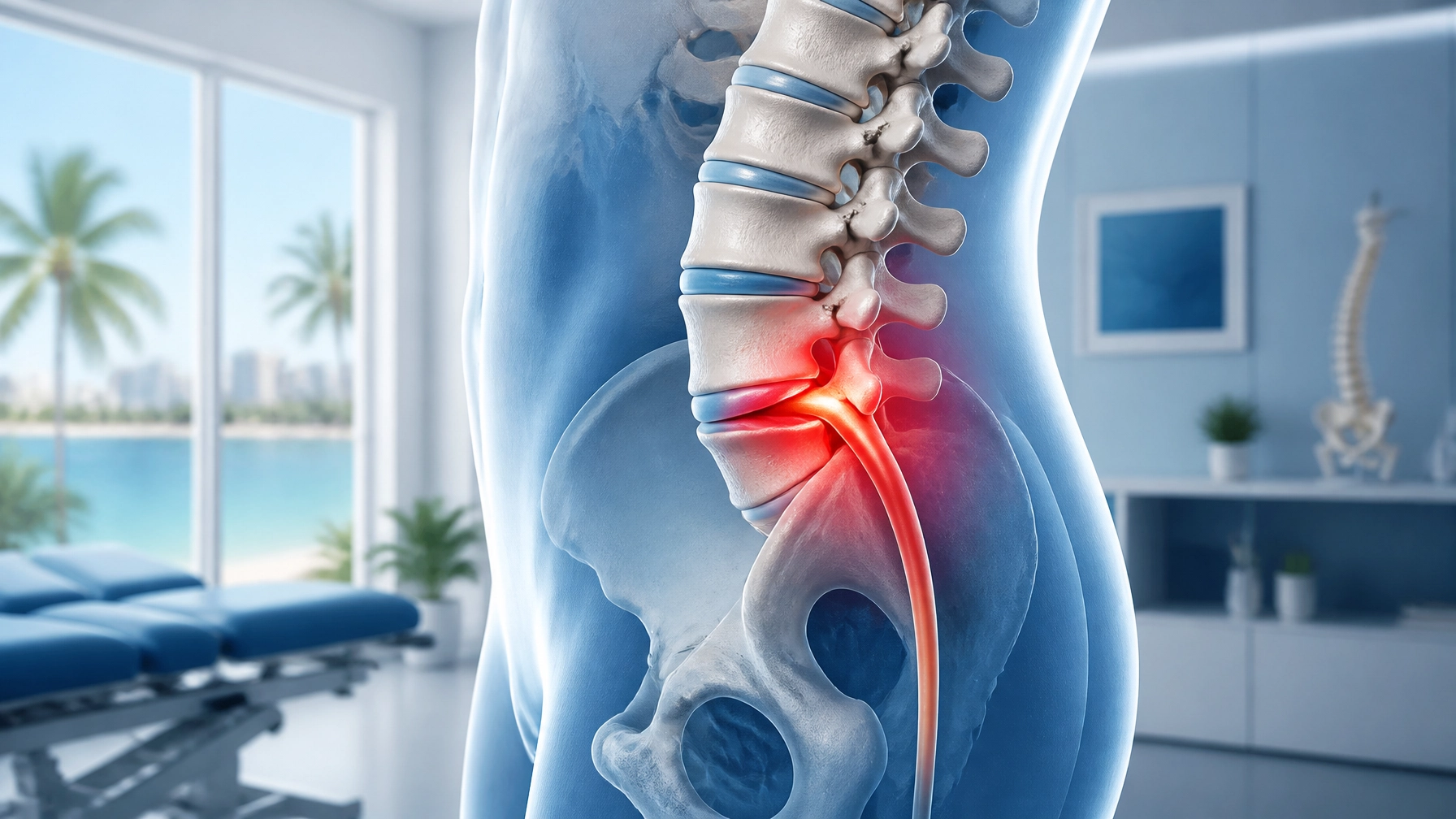
The sciatic nerve is the largest and longest nerve in the human body. It begins in your lower spine (lumbar region), travels through your pelvis, and extends all the way down the back of each leg. Because this nerve is so long, there are multiple "choke points" where it can become compressed or inflamed.
When we talk about "true sciatica," we are usually referring to lumbar radiculopathy: pain caused by a problem in the spine itself. But often, we see patients with "pseudo-sciatica," where the nerve is being squeezed by the piriformis muscle in the buttock.

Disc-Related Sciatica: The Structural Culprit
When a disc is the cause of your leg pain, it is usually due to a herniated or bulging disc. Imagine your spinal discs as jelly doughnuts; when the "jelly" (nucleus pulposus) pushes against the "dough" (annulus fibrosus) or leaks out entirely, it creates mechanical pressure and chemical inflammation on the nerve roots.
Signs Your Pain is Likely Disc-Related:
- The "Cough and Sneeze" Test: If your leg pain intensifies when you cough, sneeze, or strain during a bowel movement, this is a major clinical indicator. These actions increase "intrathecal pressure" in the spine, which pushes the disc further against the nerve.
- Worse with Bending Forward: If leaning forward to tie your shoes or picking up a golf ball triggers a sharp "zing" down your leg, the disc is likely the culprit.
- Neurological Deficits: Numbness, tingling, or weakness in a specific "dermatome" (a specific patch of skin served by a single nerve root) often points to the spine. For example, if you can’t stand on your toes or your "big toe" feels weak, the L5 or S1 nerve roots in your back are likely compressed.
- Morning Stiffness: Disc-related pain is often worse in the morning because the discs naturally rehydrate and swell while you sleep, increasing the pressure in the confined spinal canal.
Muscle-Related Sciatica: Piriformis Syndrome
Sometimes, the spine is perfectly healthy, but the sciatic nerve is being "strangled" as it passes through the hip. This is known as Piriformis Syndrome. The piriformis is a small muscle located deep in the buttock that assists in rotating the hip.
Signs Your Pain is Likely Muscle-Related:
- Deep Buttock Tenderness: If the pain is centered in the middle of your gluteal muscle rather than your low back, it’s often muscular.
- The "Wallet Sign": Does sitting on a hard chair (or a wallet in your back pocket) make the pain worse? This direct pressure on the piriformis often triggers symptoms.
- Relief with Movement: Unlike disc issues, which often hurt more with activity, muscle-related sciatica may feel slightly better once the muscle "warms up" and becomes more pliable.
- Normal Imaging: If your MRI shows a clean spine but you still have leg pain, we look toward myofascial release and hip alignment as the solution.

The Paramedic Perspective: When is it an Emergency?
With 14 years of experience in the Collier County Bureau of Emergency Services, Dr. Baumgardner brings a level of triage expertise you won't find at a standard chiropractic office. While most sciatica is manageable, certain symptoms are "Red Flags" that require immediate medical attention.
As a former flight medic, Dr. Baumgardner advises you to seek urgent care if you experience:
- Saddle Anesthesia: Numbness in the areas that would touch a horse saddle (groin, inner thighs, buttocks).
- Bladder or Bowel Dysfunction: An inability to go, or an inability to stop yourself from going.
- Foot Drop: If you are dragging your foot or can’t lift the front part of your foot while walking.
- Sudden, Profound Weakness: If your leg "gives out" and you cannot support your weight.
These can be signs of Cauda Equina Syndrome, a rare but serious condition where the nerve roots at the base of the spinal cord are severely compressed. You can read more about differentiating between mechanical back pain and ER visits in our guide: Do You Really Need the ER for Back Pain?.
The Clinical Solution: Non-Surgical Spinal Decompression
If we determine that your sciatica is indeed caused by a disc problem, we utilize the gold standard of non-invasive treatment: Non-Surgical Spinal Decompression.
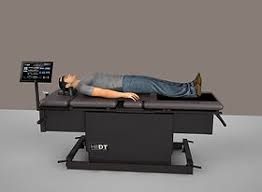
Using the state-of-the-art HillDT system, we apply computer-controlled, gentle traction to the spine. This isn't just "stretching." The HillDT table uses sophisticated sensors to bypass your body's natural muscle-guarding reflex. By creating negative pressure within the intervertebral discs, we achieve two things:
- The Vacuum Effect: It creates a gentle suction that helps pull the herniated disc material back toward the center of the disc.
- Nutrient Influx: It encourages the flow of oxygen, water, and nutrient-rich fluids into the disc to promote natural healing.
Many of our Naples patients who were told they needed surgery have found lasting relief through a series of decompression sessions. You can learn more about this technology on our Sciatic Nerve Pain Relief page.

A Holistic Approach to Recovery
We don’t just treat the spine; we treat the person. To ensure your recovery is permanent, we incorporate several holistic pillars:
- Nutritional Guidance: Chronic inflammation often fuels nerve pain. We provide personalized nutritional counseling to help reduce systemic inflammation through diet and targeted supplementation (like Omega-3s and Magnesium).
- Hydration: Your discs are approximately 80% water. If you are dehydrated: a common issue during the hot Naples summers: your discs lose their height and become more prone to herniation.
- Advanced Modalities: We often pair spinal decompression with MLS Laser Therapy, which uses specific wavelengths of light to reduce swelling around the nerve and accelerate cellular repair.

Take the First Step Toward Relief in Naples
You don't have to live with the constant "wait and see" of leg pain. Whether your sciatica is a simple muscle imbalance or a complex disc herniation, our clinical background and advanced technology are designed to get you back to your life.
We pride ourselves on honesty; if we don't believe we can help you, we will refer you to the appropriate specialist. But for many, the path to a pain-free life begins right here in our office.
Contact Us Today
Dr. Paul D. Baumgardner
671 Goodlette-Frank Rd, Suite 160
Naples, FL 34102
Phone: 239-793-3200
Website: pauldbaumgardnerdc.com
Schedule your evaluation today and let’s determine once and for all: Is it your disc, or is it just your muscles?
References and Clinical Research
- Jensen, M. C., et al. (1994). "Magnetic Resonance Imaging of the Lumbar Spine in People without Back Pain." New England Journal of Medicine.
- Koes, B. W., et al. (2007). "Diagnosis and treatment of sciatica." BMJ (Clinical research ed.).
- Grevitt, M., et al. (1994). "The natural history of lumbar disc herniation." International Orthopaedics.
- National Institute of Neurological Disorders and Stroke (NINDS). "Low Back Pain Fact Sheet."